Druggist Jack Thompson
The Thompson line: from Lowell to Cincinnati (1852–1922)
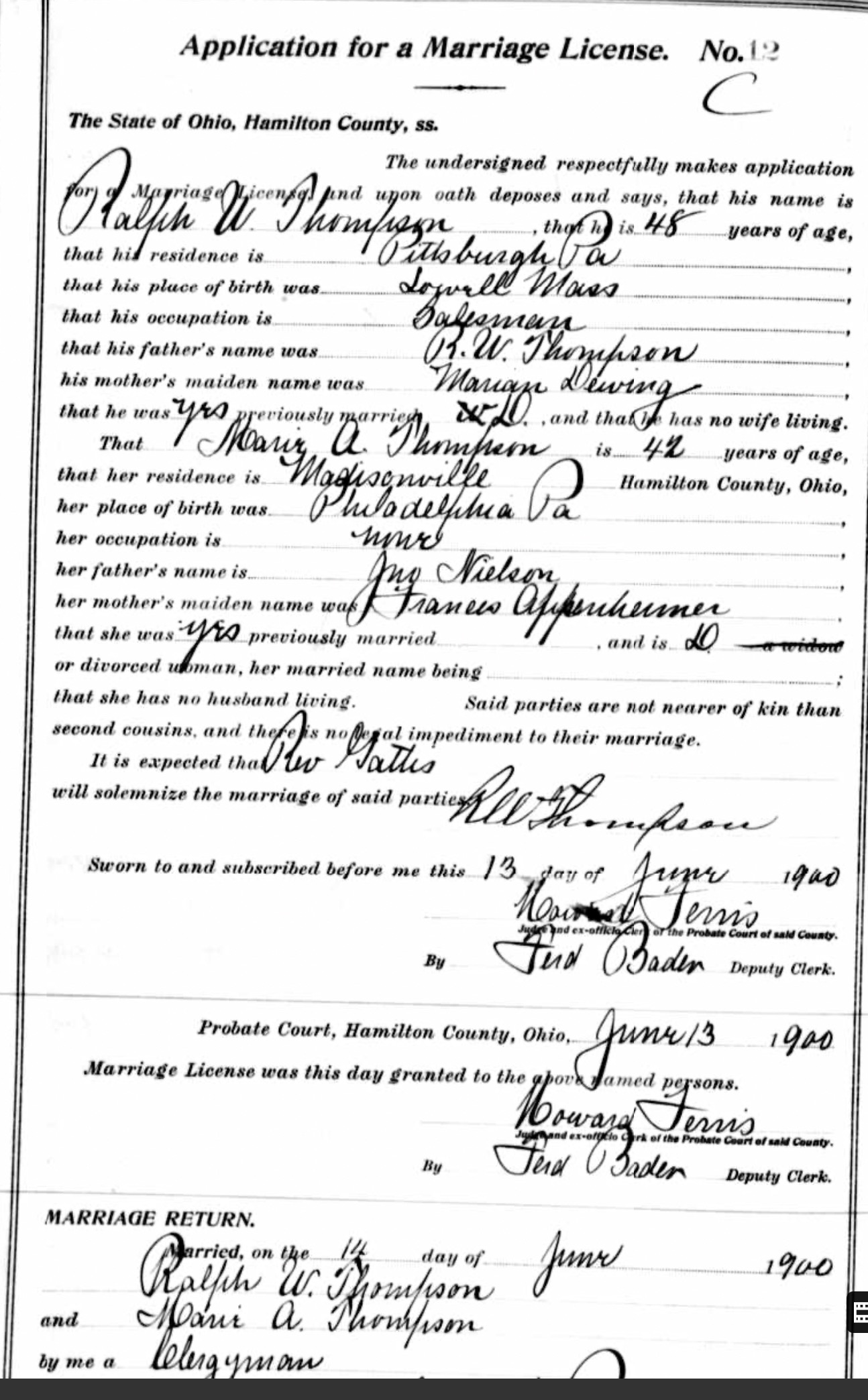
Jack Ralph Thompson's grandfather was Ralph W. Thompson Sr, born May 1852 in Lowell, Massachusetts. The 1900 US Census recorded his parents as P. W. Thompson (born in Ireland before 1830) and Marian Dewing (a Massachusetts native).56 The Thompson family ancestry research notes (artifact `steady-nest`) add a critical caveat: Ralph W. Sr was adopted. The Irish-immigrant ancestor recorded on his census entries is therefore his adoptive father, not his biological one — and the chain of Thompson surname comes through that adoption. His biological lineage has not yet been traced.57
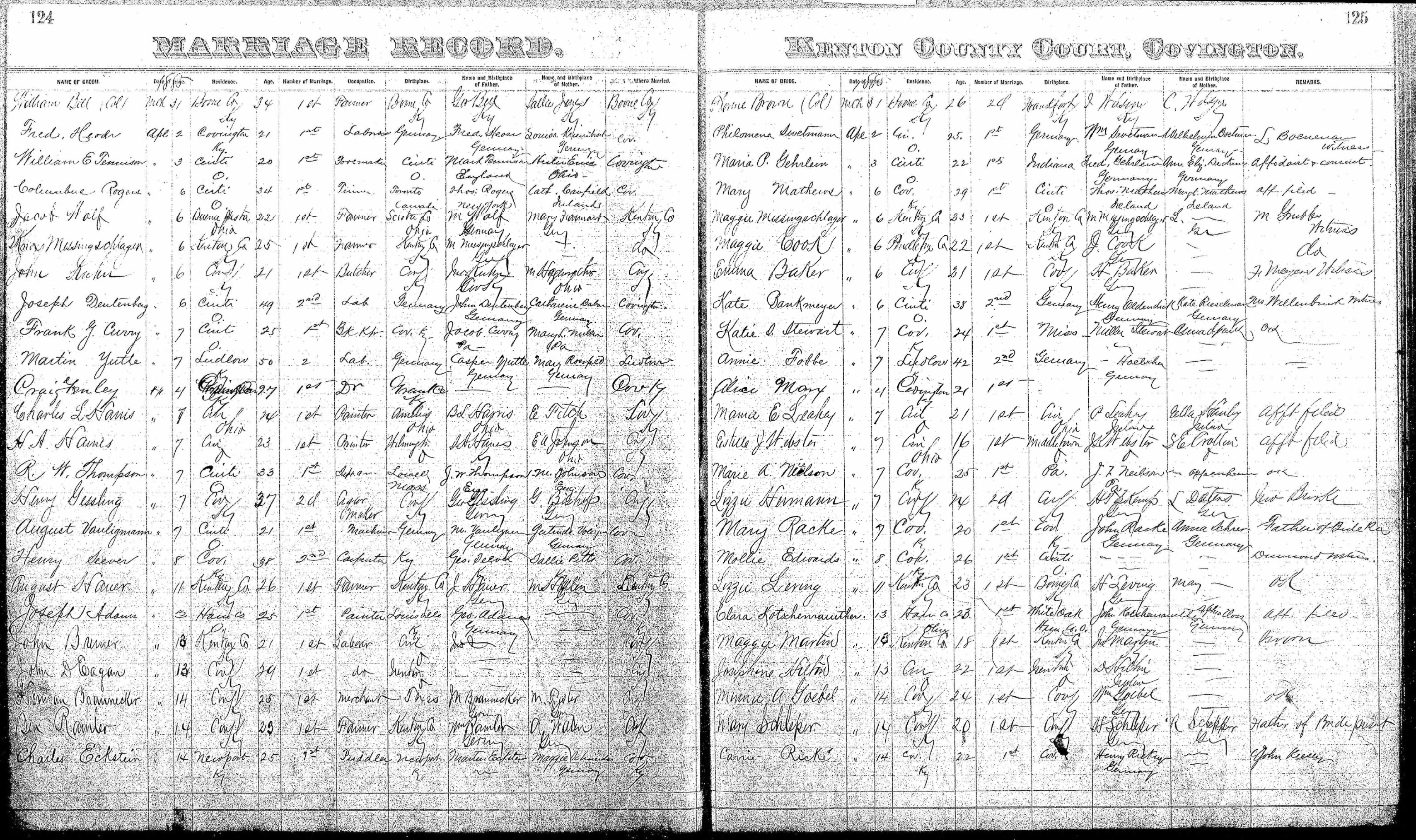
Ralph W. Sr married Marie A. Nielson twice — confirmed. First in Covington, Kentucky on April 7, 1885. They divorced at some point. Second on June 14, 1900 in Cincinnati, where the marriage certificate listed her name as Marie A. Thompson — she had retained her first married surname through the intervening divorce. The 1900 US Census, taken two months earlier, recorded them as "married 15 years" — counting from the original 1885 marriage.56
Marie was born December 27, 1858 in Philadelphia, Pennsylvania, the daughter of John Thomas Nielson (a Pennsylvania-born bookkeeper) and Frances A. Oppenheimer (Ohio-born). She died August 8, 1937 in Cincinnati and is buried at Highland Cemetery in Fort Mitchell, Kentucky, Section 4, Lot 181 — interred with her brother Harry (d. 1943) and his wife Nannie (d. 1920). The shared family plot is the documented anchor of the Nielson side of this branch.58
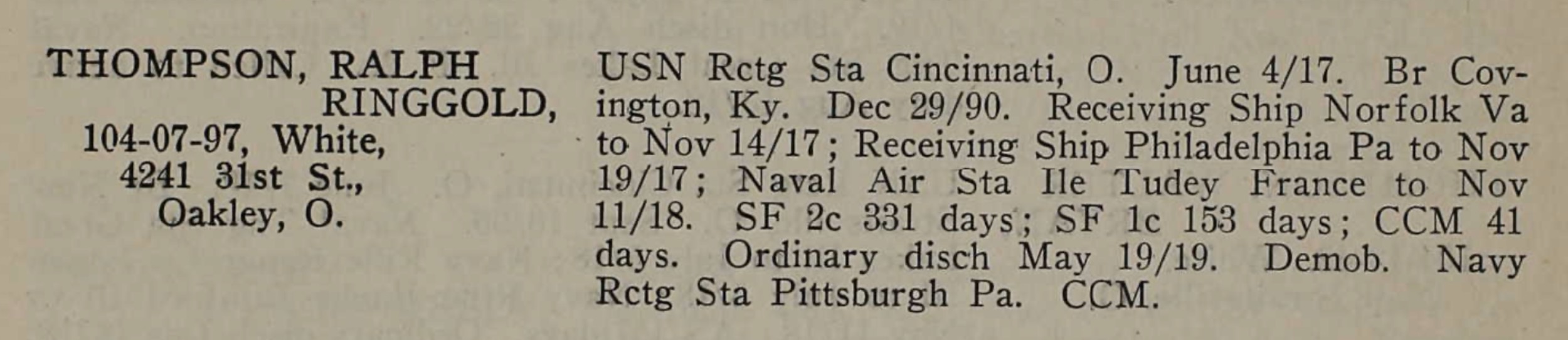
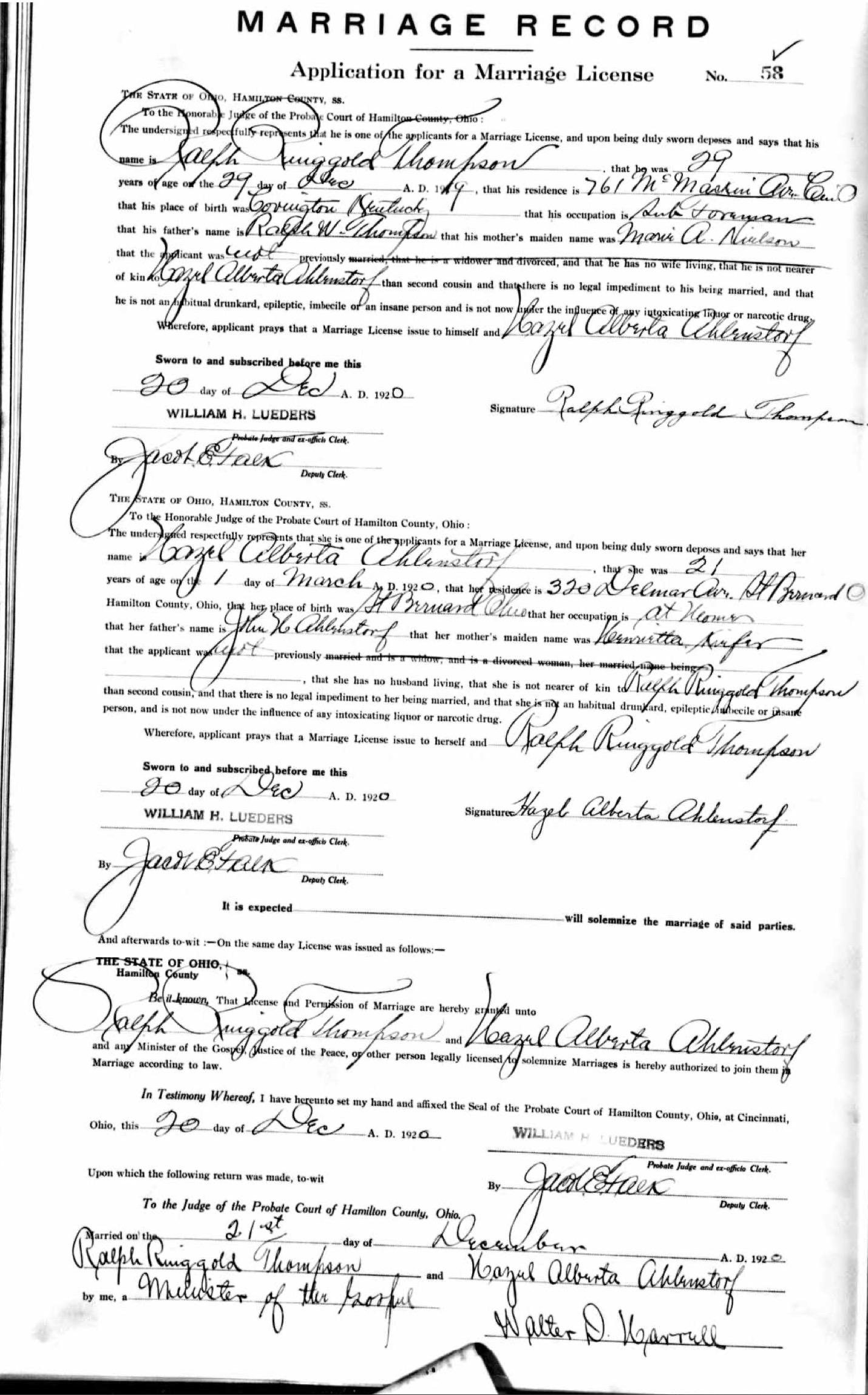
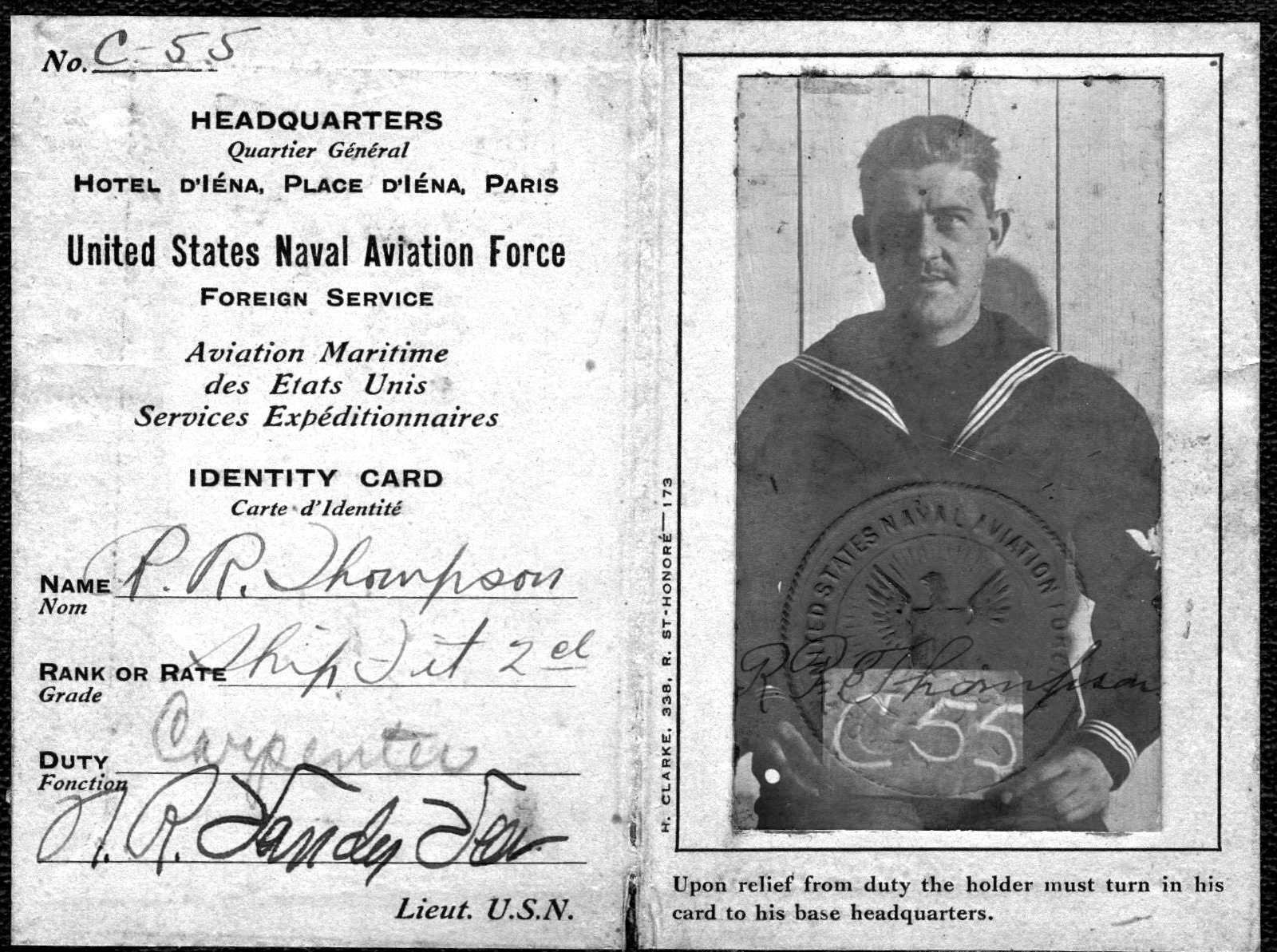
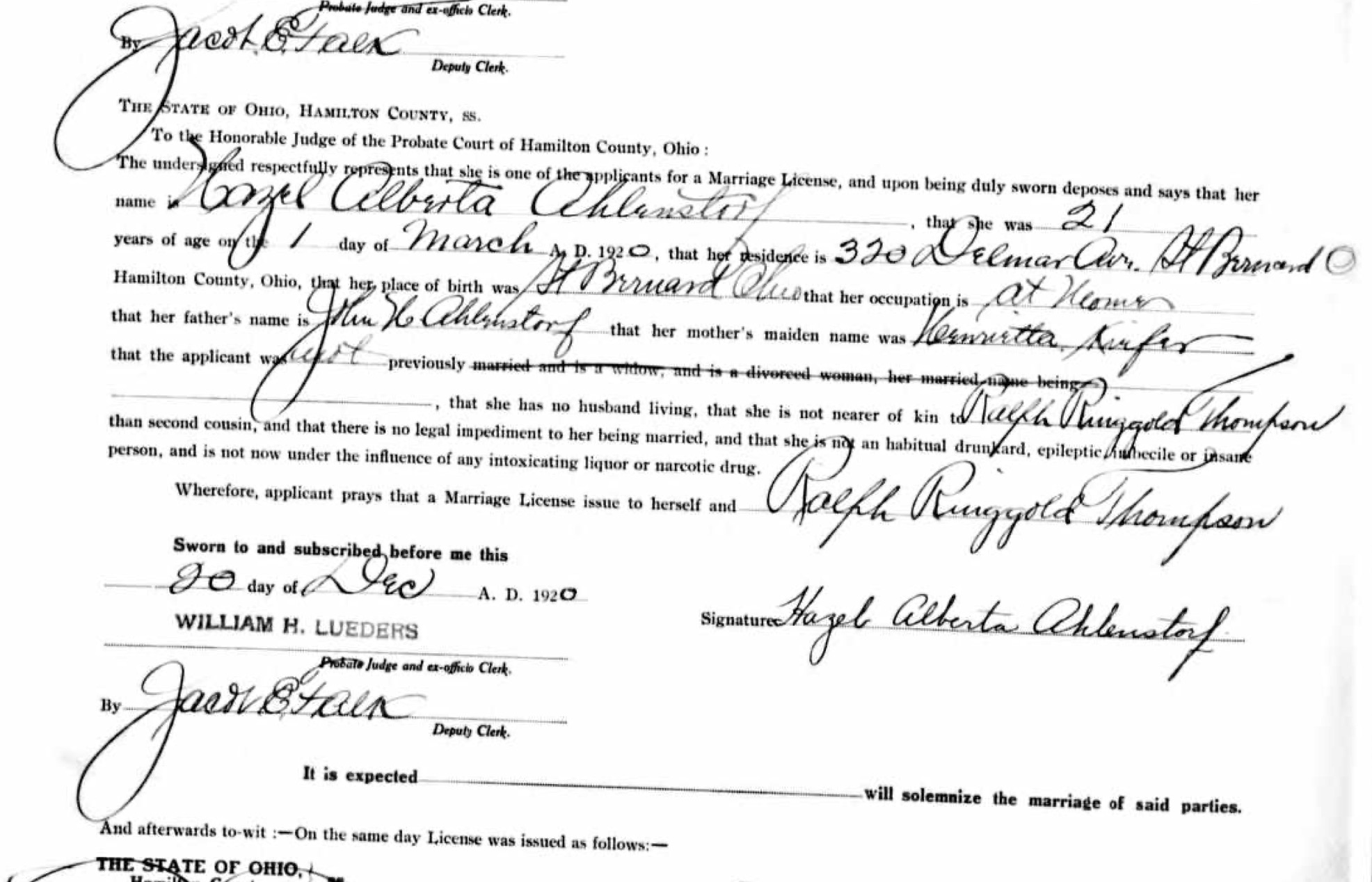
Ralph W. Sr and Marie had five sons. The fourth, Ralph Ringgold Thompson — Jack's father — was born in Covington, Kenton County, Kentucky, on December 29, 1890.2
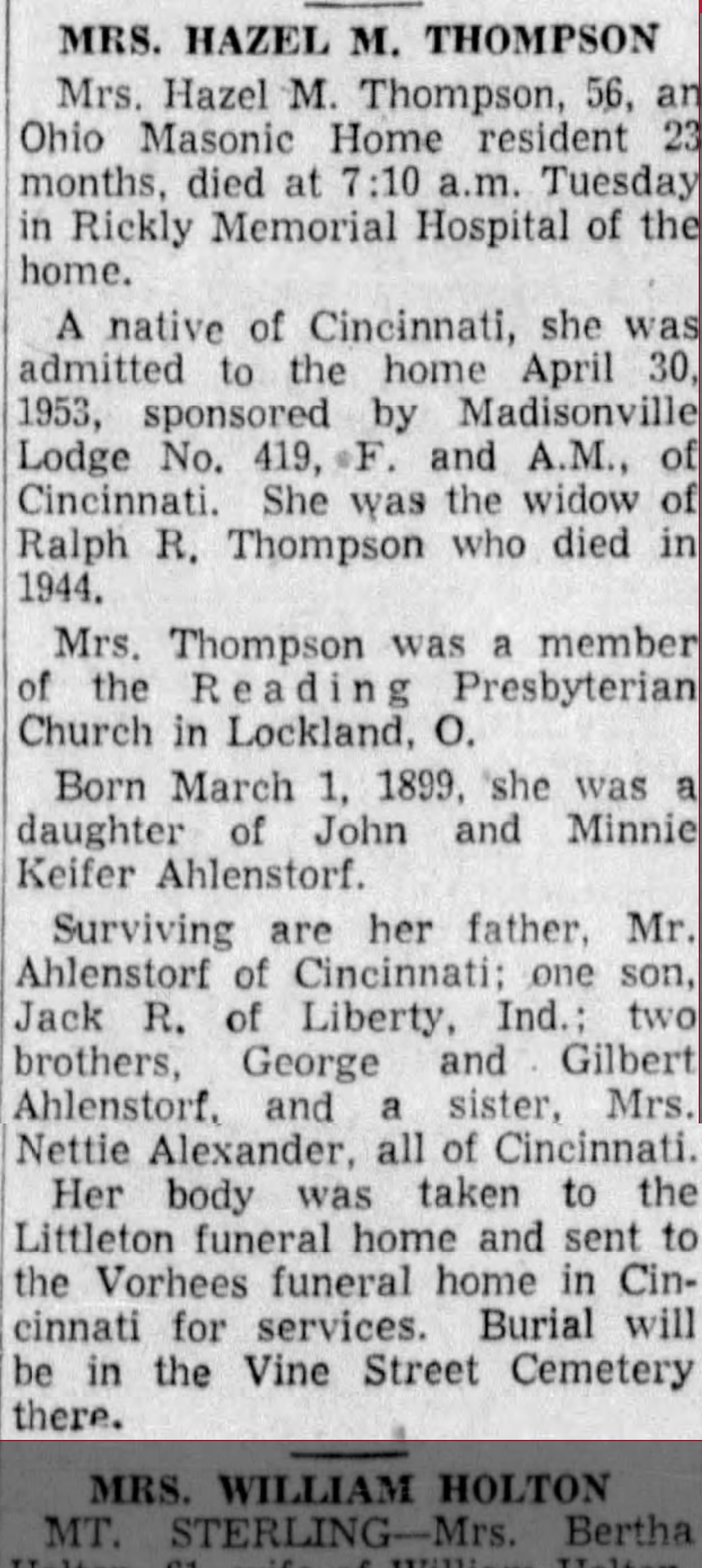
Jack's mother, Hazel Alberta Ahlenstorf, was born in Ohio on March 1, 1899. The Ahlenstorf surname traces, in this tree, to a Hanoverian immigrant who settled in Cincinnati in the 1850s — the subject of a forthcoming chapter on that earlier arrival.3,4
Cincinnati at the time of Jack's birth had a long-standing German-speaking population — second largest among American cities, by some counts, well into the early twentieth century. This is general historical context, not a specific claim about the family.5
The Oppenheimer line: Mobile, Ohio, Philadelphia (1810–1903)
Marie A. Nielson's mother was Frances Oppenheimer, born about 1833 in Ohio. Frances was one of five children of Kauffman Oppenheimer (b. ~1810) and Solidel Adele Juzan (b. June 1813 in Mobile, Alabama). Kauffman and Solidel were married in Mobile, Alabama in 1831 — Solidel's home town, where her father Daniel Juzan had been born in 1760. The Oppenheimers moved to Ohio after the marriage, then to Philadelphia between 1840 and 1850, where Kauffman ran a retail clothing business at 521 Market Street and lived at 1604 N. 6th Street through at least 1875.60
The Oppenheimer family was Jewish. They attended Congregation Rodeph Shalom in Philadelphia. The Cauffman in-laws (Esther Cardoza Cauffman married Frances's brother Elias in 1854) are recorded in Rodeph Shalom's congregational documents. Oppenheimer descendants are buried at Beth El Emeth Cemetery in West Philadelphia and at West Philadelphia Cemetery (Jewish). This is — through Frances → Marie A. Nielson → Ralph Ringgold Thompson → Jack Sr → Jack R Thompson → Benjamin Thompson — the documented entry point for Benjamin's Jewish ancestry, six generations back.60
The five Oppenheimer children, recorded in the JGSGP Chronicles 2012 article Isabella's Sampler (artifact `rugged-tea`):
- Catherine "Kate" Oppenheimer (b. ~1832 Mobile, never married) — visited Frances and John Thomas Nielson in Covington, Kentucky in 1880, which is how the 1880 census first connected the Thompson-Nielson family to the Oppenheimer line
- Elias Oppenheimer (m. 1854 Esther Cardoza Cauffman; one son Henry Emanuel, b. 14 Feb 1861, d. 13 Dec 1862 at 22 months, buried Beth El Emeth Cemetery; Elias d. New York City 1916)
- Frances Oppenheimer (b. ~1833 Ohio, m. John Thomas Nielson, settled in Covington, Kentucky; five children including Marie A. Nielson; d. ~1903 Cincinnati)
- Isabella Oppenheimer (McClellan) (b. ~1836 Ohio, m. 1870 Newton McClellan in Philadelphia, moved to Butler County Ohio; one son Newton Cauffman McClellan; d. Covington, Kentucky; buried Butler County, Ohio)
- Samuel "Simon" Oppenheimer (never married)
October 15, 2012: Isabella's Sampler returns
In 1847, eleven-year-old Isabella Oppenheimer stitched a marking sampler in Philadelphia's North Mulberry Ward — alphabet, numerals, her name, her age, the year. The sampler was a girl's standard demonstration of needlework competence, the kind of thing a Jewish family in mid-nineteenth-century Philadelphia framed and hung on a wall.61
More than a century later the sampler hung in a neighbor's home in Hamilton County, Ohio, admired by a young Kathy Argo. The neighbor promised Kathy the sampler one day; her heirs sent the estate to auction instead; Kathy's mother placed the winning bid and presented the sampler to her daughter. Years later, Kathy decided that if she could find a living descendant of Isabella she would return it.61
Kathy's 2011 Random Acts of Genealogical Kindness request in Chronicles — the newsletter of the Jewish Genealogical Society of Greater Philadelphia — was picked up by JGSGP member Ann Kauffman, who collaborated with Kathy through online research from spring 2012 forward. Working backwards from the 1880 US Census, they identified five children of Frances Oppenheimer and John Thomas Nielson in Covington, Kentucky, and traced potential living descendants of one of them — Marie A. Nielson, the family's thread to the Thompsons.61
On October 15, 2012, Jack R. Thompson (Benjamin Thompson's father, of Denver, Colorado) and his mother Virginia Thompson Howell (Virginia Bichmiller Thompson, by then remarried to Victor Howell) travelled East and met Kathy Argo at her Ohio home. The article describes the moment: "He expressed his appreciation for the genealogical search that led to identifying him as a descendant of Solidel and Kauffman Oppenheimer. He was thrilled to receive the sampler that their daughter, Isabella, had completed in 1847."61
Childhood and education (1922–1943)
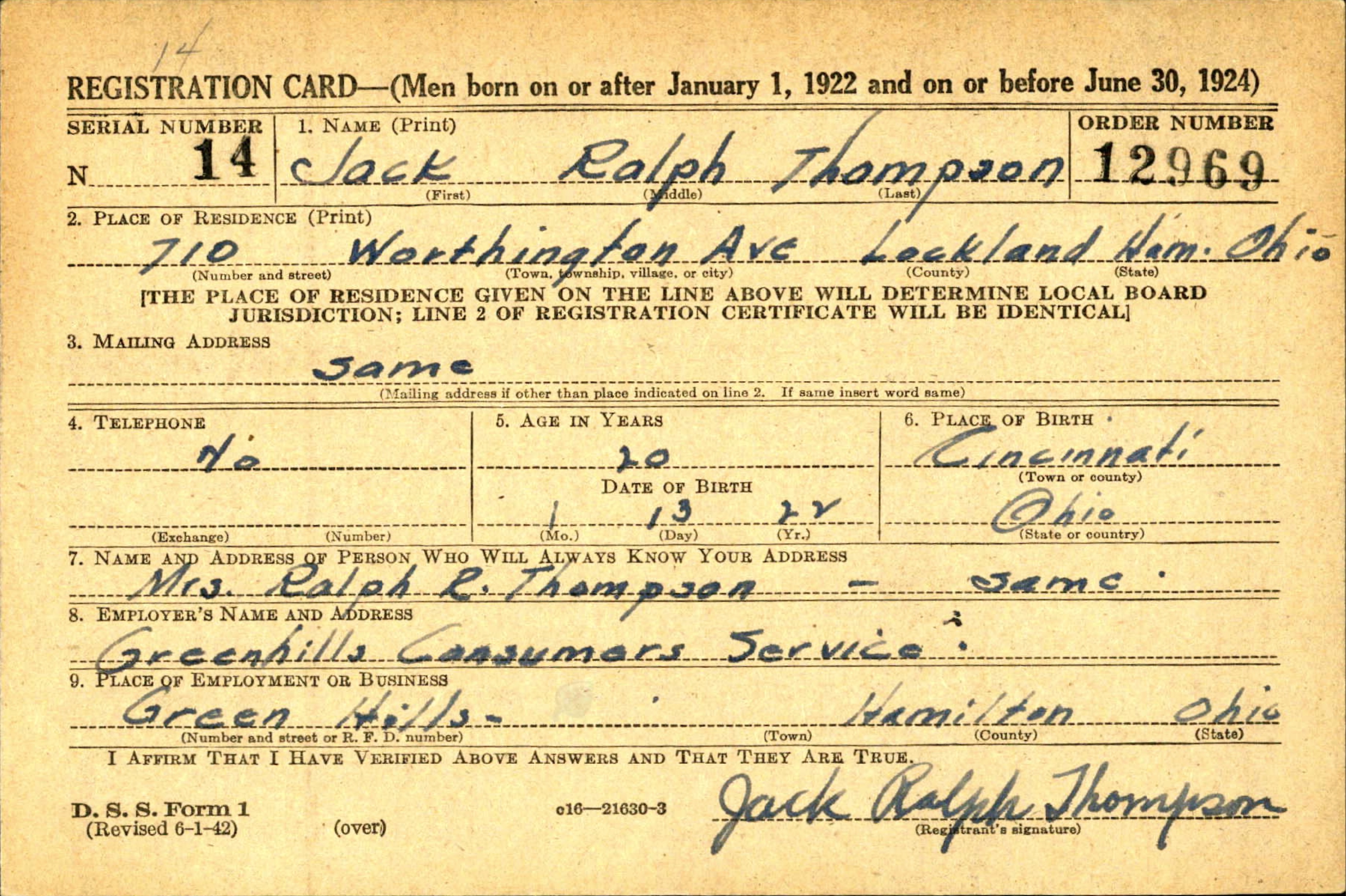
Jack Ralph Thompson was born on January 13, 1922, in Cincinnati, Ohio.1
His father Ralph Ringgold was, per Jack's own later testimony, "an invalid from the first war, being in the service" — meaning Ralph Ringgold was a World War I veteran returned disabled, a fact otherwise undocumented on this site, and one that almost certainly shaped his shortened life. Before or around the war, Ralph Ringgold was "in the construction business."37
His mother Hazel was "a supervisor for Procter & Gamble" — the Cincinnati-headquartered consumer-products giant. This is the first record on this site of her professional life.37
Jack graduated from Lockland High School in Lockland, Ohio, in 1939, and from the University of Cincinnati College of Pharmacy in 1943.19
Three of his cousins would die in World War II. The cousins are not yet identified by name in this site's GEDCOM; their absence is a known gap.37
Pre-war: the Greenhills pharmacist (c. 1941–1942)
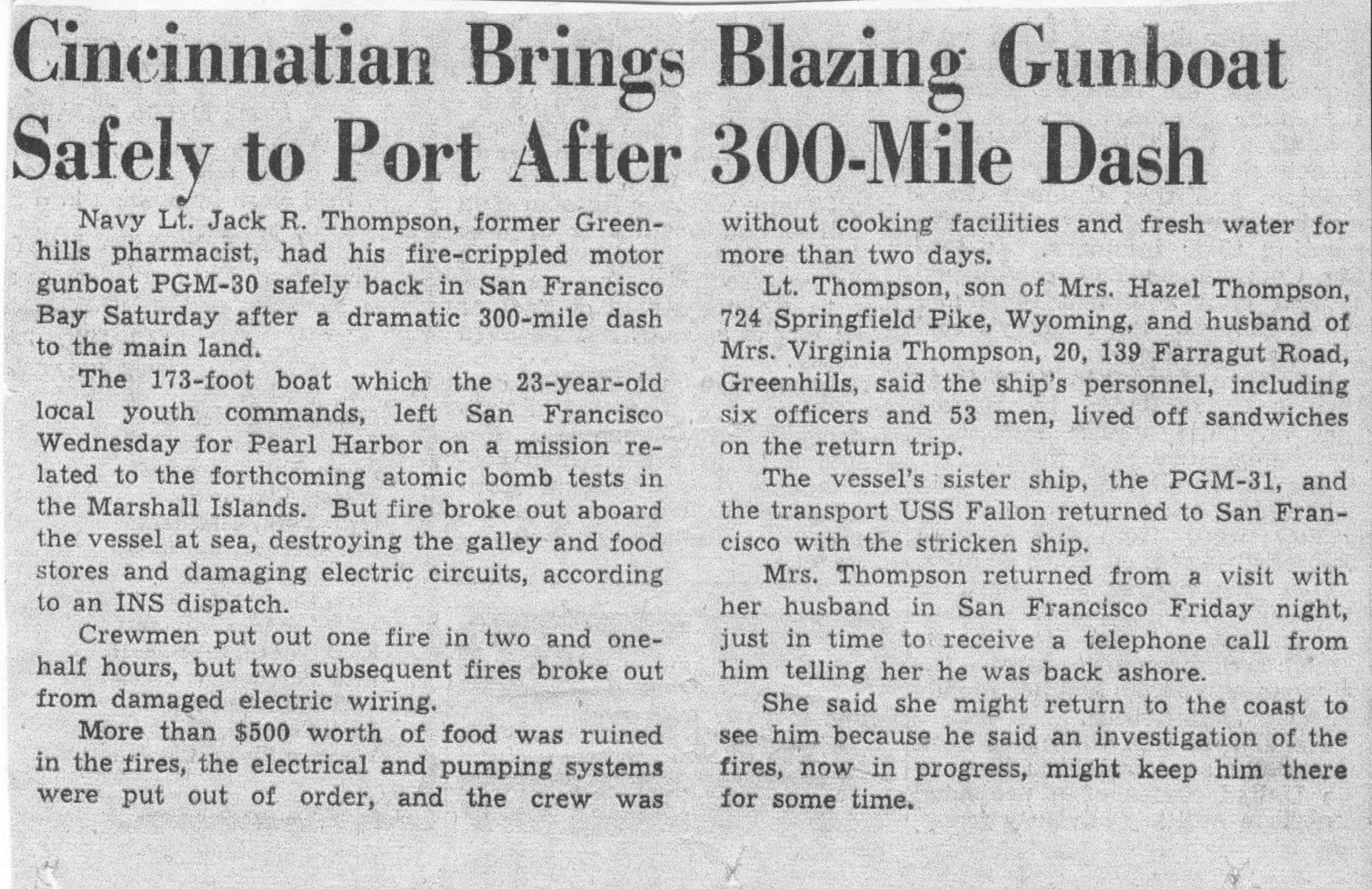
Before the war he worked as a pharmacist in Greenhills, the planned community in northern Cincinnati where he and Virginia would later live. The single surviving newspaper clipping the family preserved identifies him explicitly as "former Greenhills pharmacist" — a small detail that gives the shape of his pre-war life.13
Enlistment and training (July 1942 – December 1943)
"On July the 12th of '42, I joined the Navy." He enlisted while still a junior at the University of Cincinnati; the Navy let him finish college first.37
The draft-board comedy of errors. The Navy never told his local draft board he had enlisted. His next-door neighbor was the chairman of the local draft board and warned him "if you don't respond to our mail and our request, you could be in big trouble. You could go to jail." The Navy gave him no card to carry; a police officer stopped him for speeding, doubted his service status, and accepted a handwritten note on the back of a card identifying him as Naval Reserve.37
His first duty station was Pearl Harbor, December 1943. There he spent fourteen days assigned to a yacht donated to the Navy by the Mellon family — its specifications were in German because it had been built in Germany, and almost no one in the wartime crew could read them. "It never left the shore, and there was nothing going on." He asked to be reassigned.33
The SC-629: submarine chaser in the Pacific (1944)
His next ship became his war: the USS SC-629, a submarine chaser built at Quincy in Boston — 100 feet long, 17 feet wide, 100 tons. It had sailed itself down the East Coast, through the Panama Canal, up to San Diego, then on to Pearl Harbor. The captain, learning Jack had been an officer for thirty-four days, asked if he had sailing experience, engineering, gunnery — "anything you know?" No, he said to each. "I wondered why I'm standing here with this ship in dry dock. How am I going to get on it?"33
He served aboard SC-629 for eight to ten months as the ship's pharmacist's mate — his civilian pharmacy training pressed into emergency-medic duty. The ship worked the central and south Pacific: Palmyra Island, Johnston Island, Funafuti, and finally Espíritu Santo in the New Hebrides. The geography corroborates and refines the obituary's broader claim of "Pearl Harbor, New Hebrides, Guadalcanal, and Okinawa." These were the specific stops he named on tape.33,20
The death of the nineteen-year-old gunner. Aboard SC-629 he watched a sister ship in their convoy take casualties from a firing accident during target practice. The gunner "lost control" and fired into his own ship's pilot house because there were "no positive gun stops." Five projectiles hit eleven or twelve men; one was killed. "His chin was gone. His shoulder projectile had penetrated through his rib cage, into his lung, and this is what killed him. He drowned in his own blood." Jack — the only person aboard with pharmacy training, dispatched because there was no doctor in the convoy of seven or eight ships — gave him repeated injections of morphine and built a canopy over him on deck against the equatorial sun. The seas were too rough for a seaplane; no helicopter could land. "He was only 18 years old. I felt very badly. We could do nothing." Decades later he still remembered the boy's age, and only learned the rest by reading the commanding officer's next-of-kin letter: nineteen years old, three months in the Navy, supporting a sister and a mother back home. They buried him on Funafuti coral. "That was what made me think I should have joined the army, or something else."34,37
Decades later, working as a hospital pharmacist back in Indiana, Jack discovered that another hospital colleague, Dr. Benham, had been on the transport ship that carried that same accident's wounded home.34
1918: "U.S.N., h 4241 31st Av"
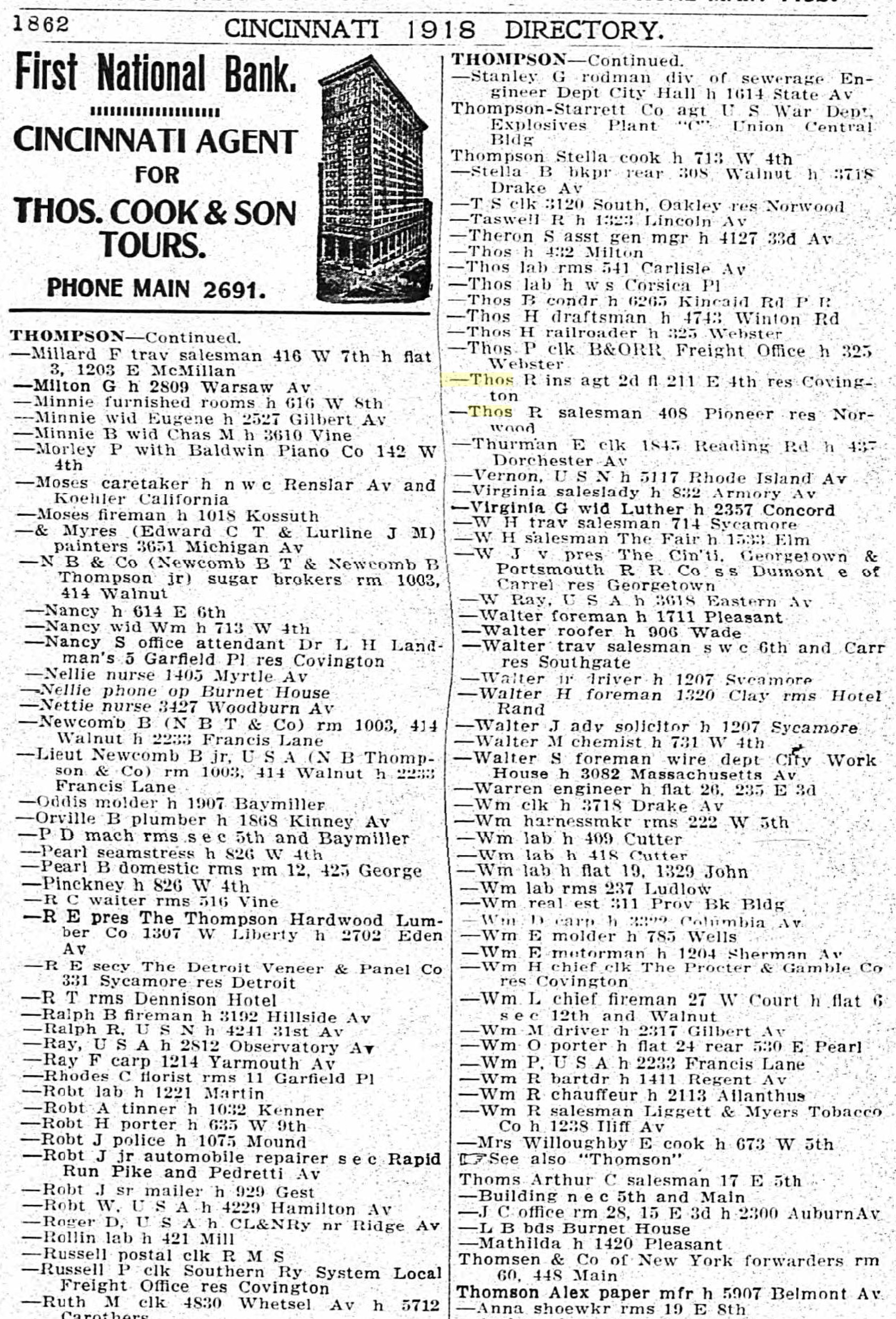
The 1918 Williams Cincinnati Directory, page 1862, captures Ralph at a moment of transition. His Thompson-section entry — in the first column — reads in full: "Thompson Ralph R. U S N h 4241 31st Av."65
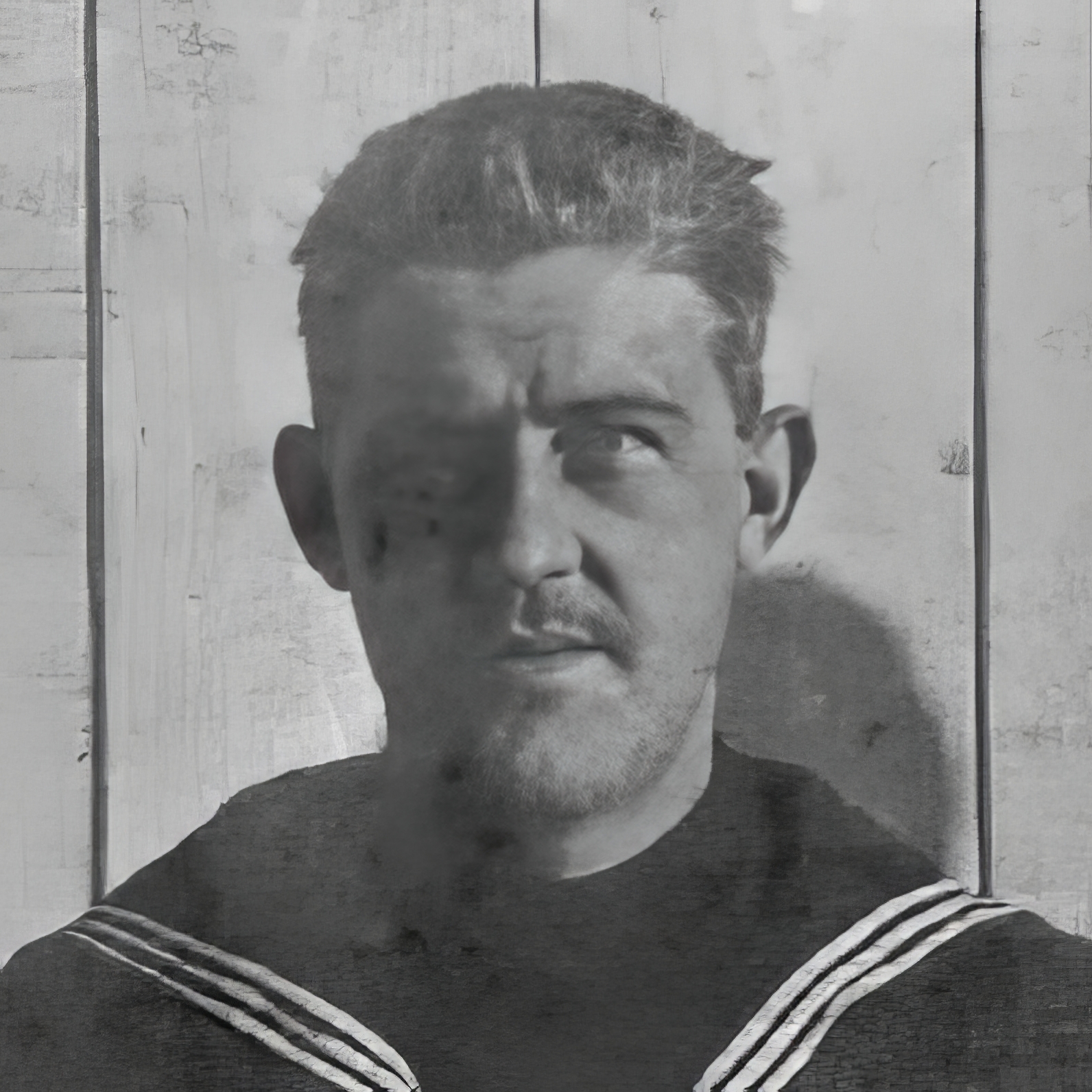
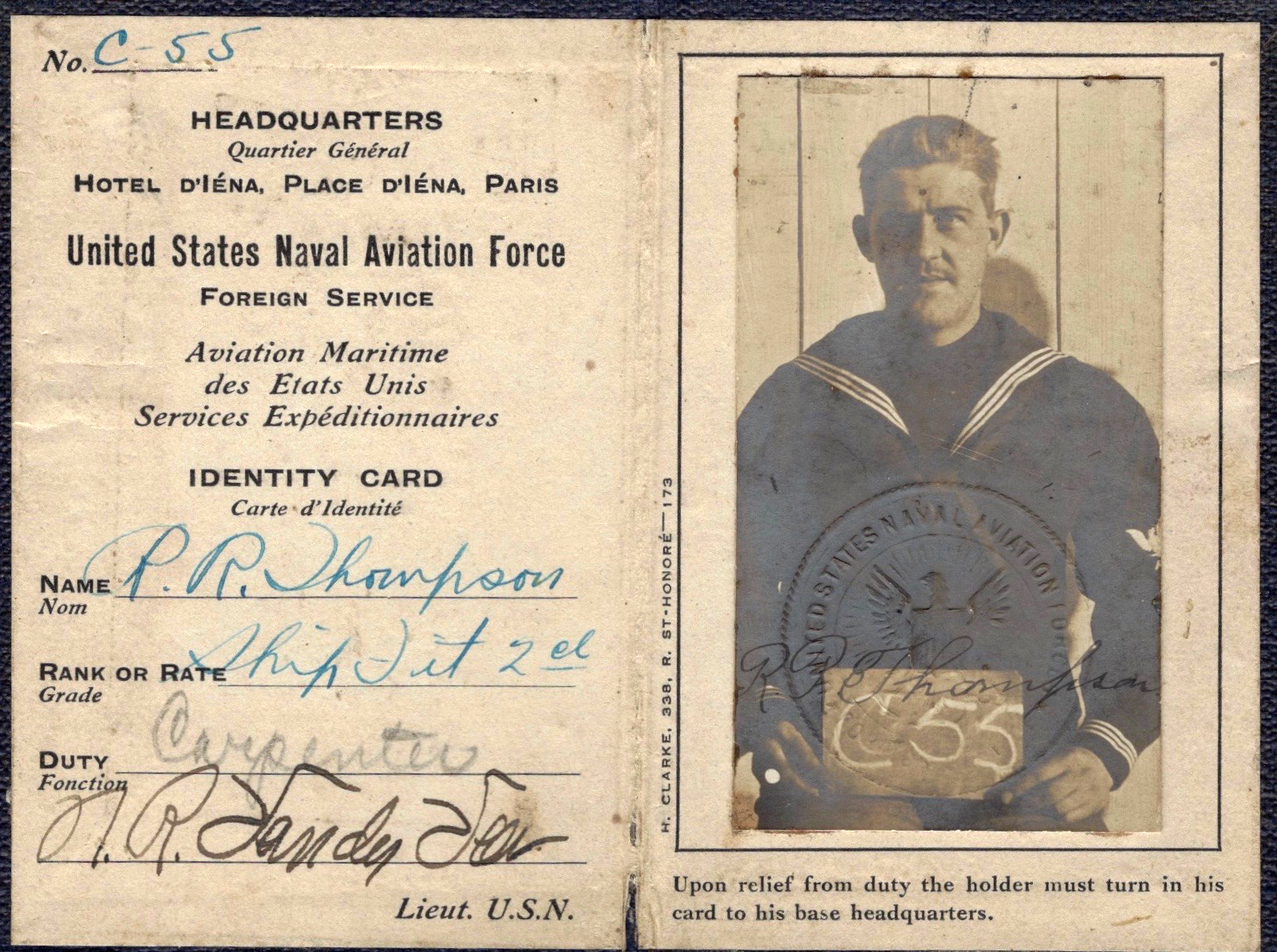
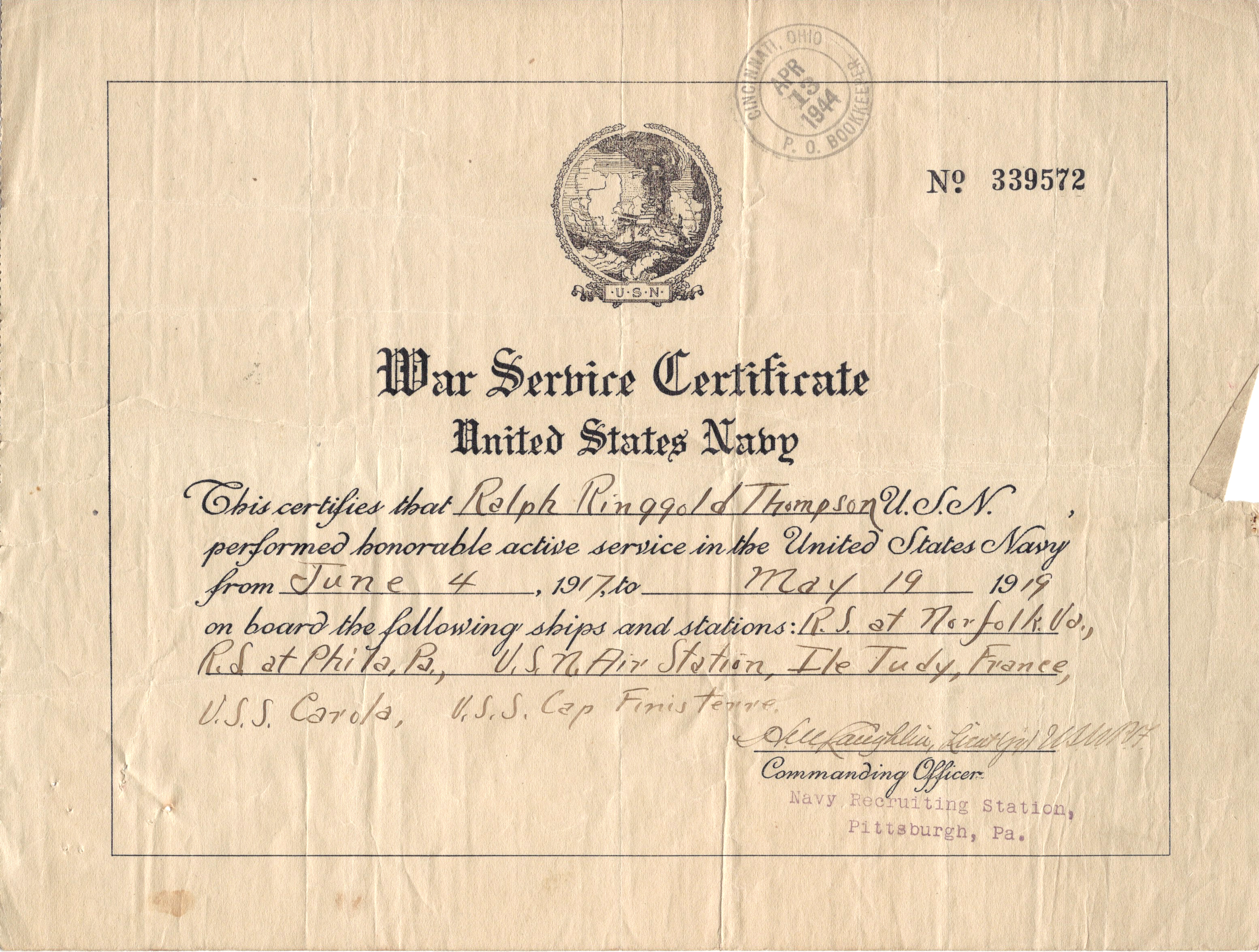
In directory shorthand: "U S N" stood for United States Navy — used where a civilian occupation would otherwise appear, indicating his Navy service was current as the directory was compiled in late 1917 or very early 1918. He had enlisted on June 4, 1917 and shipped to Naval Air Station Île Tudy, Brittany on November 19, 1917. The directory editor listed him by his then-active service rather than any pre-war trade.65
The "h" prefix on his address denoted home — the established family residence, as distinct from "rms" (rooms at) or "b" (boards). His home was 4241 31st Avenue, Cincinnati. He was 27, single — Hazel Alberta Ahlenstorf was then nineteen — and the 31st Avenue address was almost certainly the family home he had shipped out from in November 1917.65
1932: The National Home for Disabled Volunteer Soldiers
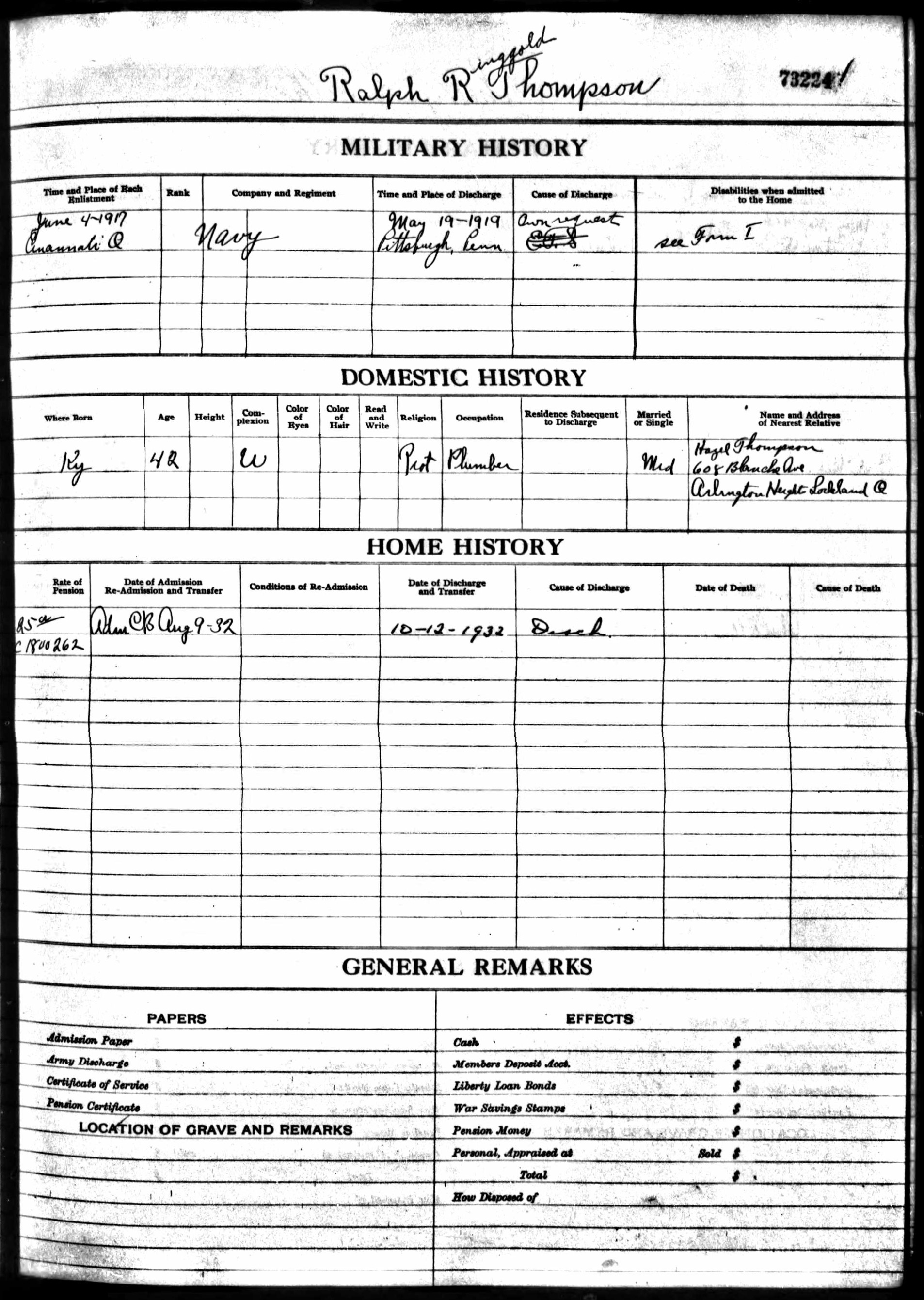
Jack's 2007 oral history described his father Ralph as "an invalid" after WWI. The hard documentary evidence: on August 9, 1932 — when Jack was ten — Ralph was admitted to the National Home for Disabled Volunteer Soldiers under record #73224.63 The register lists his occupation as Plumber, his age as 42, his wife Hazel's address as 608 [unreadable] Ave, Arlington Heights, Cincinnati — the family's pre-Greenhills home. The specific disability is recorded only as "See Form 1" (a referenced supplement). He was discharged or transferred from the home on October 12, 1932, about two months after admission.63
January 1943: Ralph administers his uncle's estate

Fifteen months before his own death, Ralph Ringgold Thompson appears in the Hamilton County Probate Court legal notice published in The Cincinnati Enquirer on Saturday, January 16, 1943, page 14 — appointed administrator of the estate of his maternal uncle Henry R. Nielson.62 Henry, born around 1865 in Ohio, was the younger brother of Ralph's mother Marie A. Nielson (d. 1937). With Marie already six years dead and Henry apparently without surviving wife or issue, Ralph — Marie's only surviving son in Cincinnati — was the natural next of kin.
April 1944: His father's death
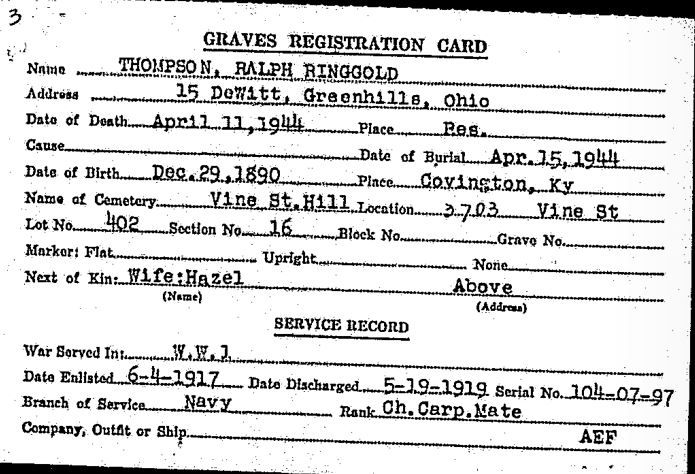
Three months after the probate appearance, Ralph Ringgold Thompson died at his home on April 11, 1944, when Jack was twenty-two and somewhere in the South Pacific. The official Graves Registration Card records the residence at death as 15 DeWitt Street, Greenhills, Ohio, and the cause as the residence itself (no hospital).8,64
Four days later, on April 15, 1944, Ralph was buried at Vine Street Hill Cemetery, 3703 Vine Street, Covington, Kentucky, Section 16, Lot 402, with a flat marker. His next of kin was recorded as "Wife: Hazel." His Navy serial number was preserved on the card: 104-07-97. Find A Grave memorial #9265776 maintains the record online.64
SC-629 redesignated; Okinawa (December 1944 – May 1945)
December 1944: SC-629 was redesignated as a Landing Craft Control vessel (LCC) in anticipation of the planned invasion of Japan. The ship spent six weeks in Tulagi, in the Solomon Islands, being refitted. Then back to Pearl Harbor, then Guam, then Okinawa — "dodging the planes and everything for a month or so."33
May 1945: his commanding officer requested orders sending him home. The Navy obliged, eventually — the officer sent to relieve him couldn't find him, passing him in transit from Guam to Guadalcanal to Pearl Harbor to Okinawa while Jack chased home in the reverse direction. He finally caught passage on a troopship with 10,000 others, cabins reconfigured to hold nine men where two used to sleep. Seventeen days later he arrived in San Francisco — the first troopship to dock there after the Japanese surrender.33
Marriage to Virginia, and a Pacific command (September – December 1945)
He went home and married Virginia Bichmiller, born in Cincinnati on August 28, 1925. He was promptly ordered to a Navy course in Brooklyn. The Navy paid for the hotel; he and Virginia honeymooned in New York on the government's dime, calling in at noon each day. After eleven days the Navy reassigned him: Sasebo, Japan. "I didn't even know where Sasebo, Japan, was. Brooklyn, New York, look on a map. You run off the edge of the map so far."6,33
In the Pacific he was given his own command — what he later remembered as a small ship of about seventy-nine feet, sixty men — and brought it from somewhere near Japan back to San Francisco. The day of his change-of-command ceremony was the day Virginia arrived in San Francisco to see him. This is the ship — the PGM-30 — whose fire-crippled return to San Francisco the Cincinnati newspaper clipping documents. The contemporaneous newspaper recorded the ship as 173 feet long with six officers and fifty-three enlisted men under his command; the 60-year-later oral history remembered it smaller. Either way, this was his second wartime ship and the one that finally brought him home.14,33
January 1946: The PGM-30 fire
The PGM-30's January 1946 mission was, technically, postwar. The Navy had sent the boat from San Francisco toward Pearl Harbor on a mission related to the forthcoming atomic bomb tests in the Marshall Islands — what the world would come to know as Operation Crossroads, the two nuclear detonations at Bikini Atoll in July 1946. Jack's ship was part of the support flotilla being assembled.15
On the outbound run, the PGM-30 caught fire at sea. The fire destroyed the galley and the food stores, damaged the electric circuits, and forced the boat to turn back toward the mainland. The crew put out one fire in two and a half hours; two subsequent fires broke out from the damaged wiring. Three fires. More than five hundred dollars' worth of food was ruined, and the electrical and pumping systems failed. The crew lived off sandwiches for more than two days — no cooking, no fresh water — while Jack pushed the burning ship the three hundred miles back to San Francisco Bay. The PGM-30 made it. The sister ship PGM-31 and the transport USS Fallon escorted them in.16
The clipping records the family addresses of the moment: Hazel — by then a widow of two years — was living at 724 Springfield Pike, Wyoming, a suburb of Cincinnati. Virginia, twenty years old, was living at 139 Farragut Road, Greenhills. She had been in San Francisco visiting Jack on Friday night and was on her way back to Ohio when he telephoned to say the ship was safe ashore. An investigation of the fires kept him in San Francisco for an indeterminate stretch afterward; Virginia "said she might return to the coast to see him."17,18
Discharge, the surplus office, and Eli Lilly (1946–1950)
"I wasn't discharged. I was ordered to inactive duty. I was in that state from '46 to '53." He spent seven years on the inactive list.35
His first postwar civilian job — bridging his Navy years and the move to Liberty, Indiana — was at the Material Redistribution and Disposal office in Cincinnati, disposing of Navy surplus property. He had six enlisted men working for him, an office eighteen miles from his home, and a half-day off each week. He had told the personnel officer, when offered an accounting-adjacent role: "With due respect to accountants, send me — the Navy, you'll never know the difference." The officer agreed.35
After his discharge from active duty in 1946, he was employed by Eli Lilly in Richmond, Indiana, as a pharmacist and medical service representative.21
Liberty, Indiana: the pharmacy years (1950–1967)
In June 1950 he purchased the Berman Drug Store at the corner of Union and Market Streets in Liberty, Indiana, and reopened it as the Jack Thompson Pharmacy.22 For the next seventeen years he was the town's druggist — the place where prescriptions were filled, school injuries were patched, and (on the evidence of the 1967 article below) the front windows were decorated for the high school basketball team's tournament run.
The Korean War recall, age 28. In 1950, just after he bought the Berman Drug Store, the Navy was "looking for qualified deck officers" — a classification he held; he was already in the Naval Reserve. "My friends in Cincinnati were being called. And I could imagine. I was married and had two children and had a drugstore… It was a rather hectic time for me. But I did not get activated." The Navy called him to Indianapolis for a physical; he drove there, waited four hours for a doctor who never showed up, and walked away released from the recall. He stayed in the Naval Reserve for eleven years total without ever being reactivated.35,37
While living in Liberty he served multiple terms on the Union County School Board and was a member of Edwards Memorial Methodist Church. He belonged to Masonic Lodge 14, F & AM; the Indianapolis Valley Scottish Rite; and the Murat Shrine.24
March 1955: His mother's death
Hazel Alberta Ahlenstorf died on March 29, 1955, at the Ohio Masonic Home in Springfield, Ohio, at age fifty-six. Jack — by then thirty-three, two years a pharmacy proprietor in Liberty — was her only child.9
March 1967: The Lancers and the pharmacy windows
By the spring of 1967, Jack had become enough of a Liberty fixture that the regional newspaper used him as the embodiment of the town's mood. On Thursday, March 9, 1967, the Palladium-Item and Sun-Telegram of Richmond, Indiana, ran a feature by Ron De Mao on Liberty's reaction to its Lancers basketball team reaching the Sweet Sixteen (the Indianapolis Semistate) of the legendary single-class Indiana state tournament. The photograph that ran with the article shows the front of his pharmacy, the windows decorated with hand-painted signs reading "LANCERS — INDIANAPOLIS BOUND", and the caption identifies him by name.36
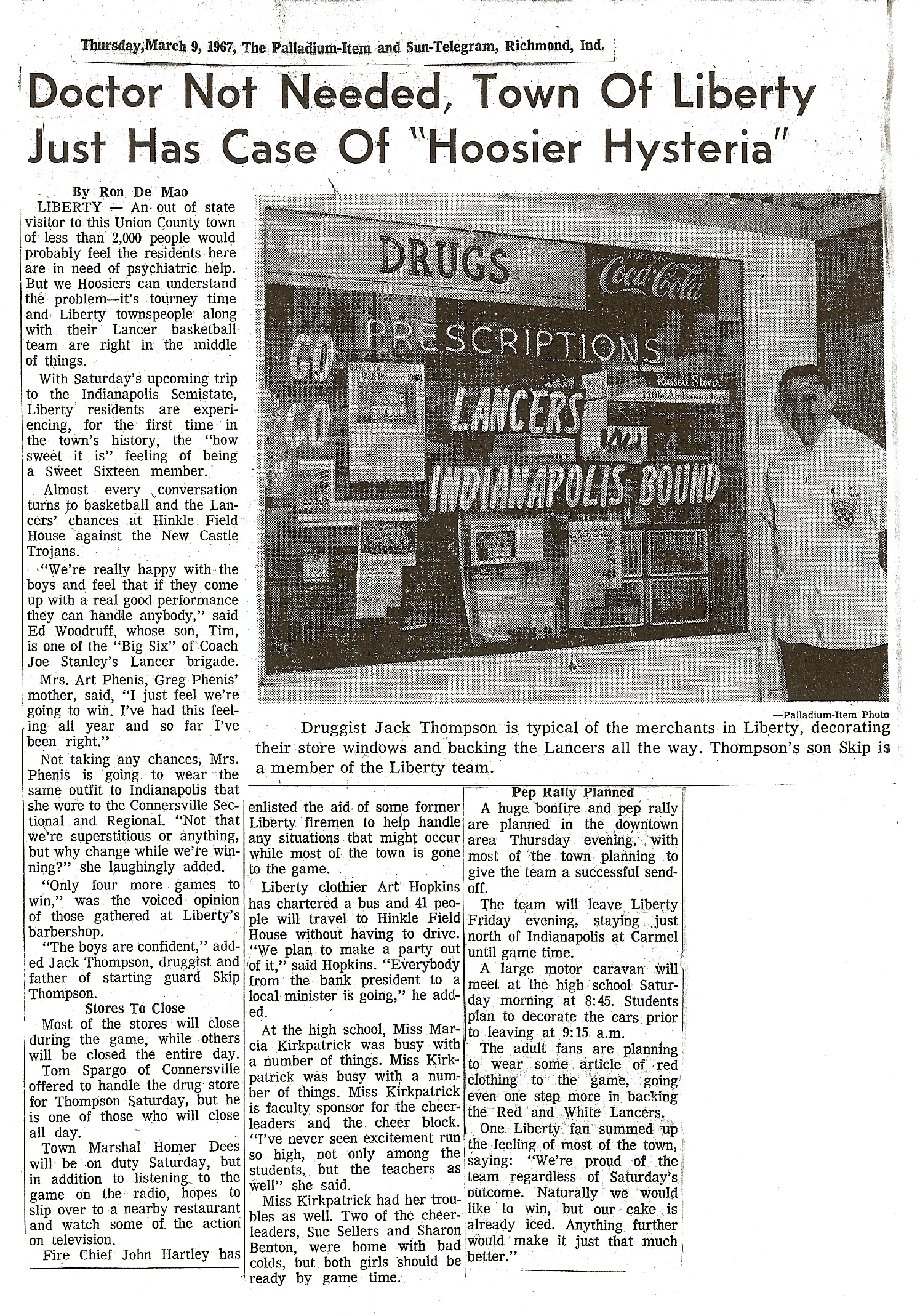
"Druggist Jack Thompson is typical of the merchants in Liberty," the caption reads, "decorating their store windows and backing the Lancers all the way. Thompson's son Skip is a member of the Liberty team." In the body of the article, De Mao quotes Jack directly: "'The boys are confident,' added Jack Thompson, druggist and father of starting guard Skip Thompson."36
The starting guard named as "Skip" in the 1967 article is Jack R Thompson — born March 21, 1949, the son of Jack Sr. (this chapter's subject) and Virginia Bichmiller, and the father of Benjamin Andrew Thompson (the author of this site).7 Skip was his childhood nickname; he dropped it in college and has gone by Jack R Thompson ever since. The 1967 article therefore is the first published reference on this site to the man who would become Benjamin's father.
The 1970 marriage: when Thompson met Hofmann
On September 6, 1970, Jack R Thompson — Jack Sr.'s son — married Jennifer Hofmann. The marriage is genealogically significant for this book in particular: it joined the two surname lines the Thompson · Hofmann · Kipp book is structured around — the Thompson line of which Jack Sr. is the centerpiece, and the Hofmann line that constitutes the Knipp · Hofmann · Bichmiller half of the family record. Benjamin Thompson, the author of this site, descends from that 1970 marriage. The Hofmann chapters elsewhere in this book are therefore not a parallel family — they are Benjamin's other half.
Hospital and retail pharmacy: the long second career (1967–c. 2003)
After selling the pharmacy in fall 1967, he spent another thirty-five years in the pharmacy profession as a hospital and retail pharmacist in Indiana and Illinois. The obituary names some of the stops: Fayette Memorial Hospital, Reid Memorial Hospital, Henry County Hospital, the University of Illinois Student Health Center, and Wal-Mart. He was also a pharmacist at Dunn Memorial Hospital in Bedford, Indiana, for twelve years. His professional career in pharmaceutical-related positions spanned sixty-five years.23
"I think I worked in a total of 10 hospitals," he said in 2007, "starting way over by Richmond, Indiana all the way down to Jasper." And: "I worked for Walmart in 14 different stores for five years." The Indiana pharmacy career he summarized in his obituary spread across more places than the obituary names.37
Second marriage: Violet Smith (December 1973)
On December 15, 1973, in Urbana, Illinois, he married Violet Smith of Bedford. She survived him at his death in 2009.26
January 1978: The blizzard arrival in Bedford
He was at the University of Illinois Student Health Center pharmacy when he interviewed for a job at a Bedford hospital. "We were on our way from Champaign, Illinois… by the time we got to Indianapolis, it was kind of sprinkling something else. By the time we got north of Bloomington, we couldn't see a thing… We came for one day and stayed four." He was hired and moved permanently. The blizzard reference dates the move exactly: the Great Blizzard of January 26, 1978.37
May 2005: The Library of Congress interview
In 2005, at age eighty-three, Jack participated in the Library of Congress Veterans History Project — a national initiative of the Library's American Folklife Center to record the firsthand accounts of American war veterans. He was interviewed in Bedford, Indiana by Patricia H. McClain and Rachel Rea of Senator Richard G. Lugar's Veterans History Project team. The recording runs 30 minutes 14 seconds.30,32
On June 15, 2005, Senator Lugar — then Chairman of the Senate Foreign Relations Committee — wrote a letter on official United States Senate letterhead to Benjamin Thompson, Jack's grandson, confirming that the interview had been reviewed and forwarded to the Library of Congress for inclusion in the permanent National Veterans History Collection, cataloged by the American Folklife Center as AFC/2001/001/41846.30,31
c. 2007: A second oral history in Bedford
Around 2007 — twenty-nine years after he arrived in Bedford, Indiana, in the January 1978 blizzard — Jack sat for another oral-history conversation, longer and more conversational than the 2005 Library of Congress interview. The recording runs over an hour and includes three other voices: a primary interviewer, a brief second voice, and a fellow veteran named Fred whom Jack cites at minute 62.37
Total Navy time, summarized. "I spent about four years on active duty in the Navy. I spent three trips overseas. First one was almost two years. The second one was six months. The third one was two days." — The two-day trip is the PGM-30 fire of January 1946.37
The friend who calls every ten days. "I talk every ten days to a man… I was in the service with, 1943. Still, he lives in Fort Thomas, Kentucky. We talk every ten days or two weeks. And he'll call me and say, 'This is another anniversary, Thompson. This is the day we went to the Navy.'"37
February 2009: Death and survivors
Jack Ralph Thompson died on February 24, 2009, at Stonebridge Health Campus in Bedford, Indiana, at the age of eighty-seven.28 A memorial service was held on Saturday, February 28, 2009, at the First Presbyterian Church, 1504 L Street, Bedford. Arrangements were under the direction of Ferguson–Lee Funeral Home of Bedford.29
The obituary names four surviving children: daughters Kathie Matney (Richard) of Connersville, Indiana, and Vanessa Hardin (Marc) of Greens Fork, Indiana; sons Paul of Indianapolis, and Jack (Konnie) of Denver. He left nine grandchildren and nine great-grandchildren.27
His former wife Virginia Bichmiller — mother of Jack R Thompson and the family from whom this branch of the tree descends — outlived him by fourteen years, dying on April 8, 2023.11 In the years after Jack's marriage to Violet, Virginia had married a second time, to Victor Howell, who appears in the family tree as a step-grandfather to Jack and Virginia's grandchildren rather than as a biological forebear.12
Artifacts
Photos, scans, and documents that back this chapter. Each carries a SHA256 fingerprint so the file can be independently verified as unchanged since upload, and a short code — the tiny adjective-noun pair below each card — for compact reference (e.g. lineage.sent.li/a/sage-pine).