Acaiaca
Acaiaca is a municipality in the interior of Minas Gerais, Brazil, in the Vale do Piranga region. It is the village the family's typed history names as the destination of João Elias's journey from Syria, and the place where the Oliveira family — Vó Fia's family — moved to in 1930.1
When João Elias arrived from his passage through France and Rio de Janeiro, the typed history says simply that he came to "povoado de Acaiaca, onde tinha família" — to the village of Acaiaca, where he had family. The Tio Miguel he was looking for was already there.2
Vó Fia's family — Augusto José de Oliveira, Bárbara Lopes, and their four children — moved to Acaiaca in 1930, when Fia was six years old. Her mother ran a venda there that sold even bacalhau norueguês, Norwegian salted cod — a small detail that fixes the village's commerce in time. A village shop selling imported Atlantic fish to a Minas Gerais interior settlement is the kind of detail that tells you Acaiaca was connected, however far inland.3
In 1943, Vó Fia married Vô Tony in Acaiaca. They began with coffee, rice, and corn — the agricultural staples of the region.4
What we know about Acaiaca itself, drawn from public sources rather than the family's own papers: Acaiaca was elevated to the status of municipality in 1962, separating from the parent municipality of Diogo de Vasconcelos. Before that it was a povoado — a settlement — which is exactly the word the typed family history uses. The village sits in the iron-mining region of central Minas Gerais; the mining industry that surrounded it is what produced the catastrophic Mariana dam disaster in 2015, which the Cris and Gorette interview references obliquely when speakers discuss the family's property losses connected to a mining company.5
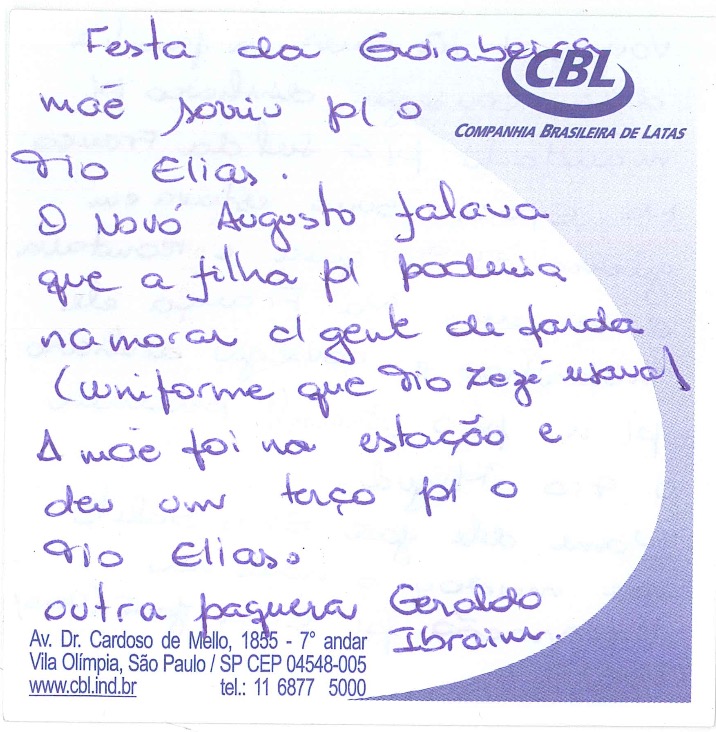
The Festa da Goiabeira — the guava-tree festival — is mentioned in one of the handwritten notes in the Familia Elias PDF as an event associated with the family. The note specifies that the mother washed (or sewed) for Vô Elias and that Vovô Augusto (Vó Fia's father) used to talk about a daughter dating someone in uniform. These are fragments of family tradition the chapter cannot fully reconstruct — but they place the family in the festival life of small-town Minas Gerais in the early to mid twentieth century.6
Artifacts
Photos, scans, and documents that back this chapter. Each carries a SHA256 fingerprint so the file can be independently verified as unchanged since upload, and a short code — the tiny adjective-noun pair below each card — for compact reference (e.g. lineage.sent.li/a/sage-pine).