The Syrian Arrival
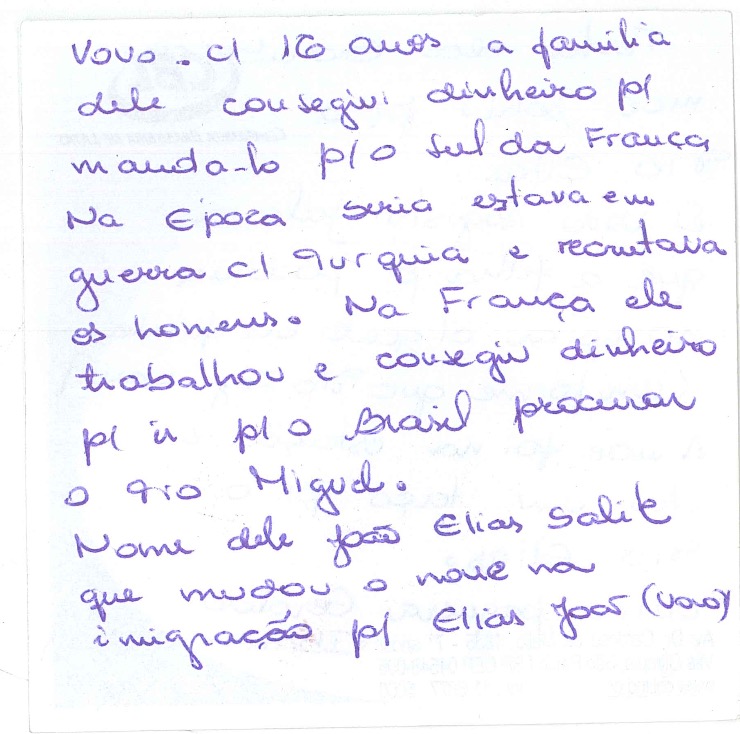
João Elias is the name by which the family knows him. His own name, at birth, the family does not remember with certainty. In the recorded family conversation in which his great-grandchildren and their elders try to recall it, the proposed forms include Elias Salit (the handwritten note: "Nome dele foi Elias Salit, que mudou o nome na imigração para Elias José"), Salim Salette, and simply some name that was changed during the immigration process at Rio de Janeiro. The family says it openly: "ninguém sabe o nome dele" — no one knows his name. He chose, at the moment of arrival in Brazil, what he would be called for the rest of his life.1
The narrative as it was passed down is this: his family in Syria managed to find money to send him to the south of France at age sixteen. Syria was at war with Turkey at the time, and recruiting men. In France he worked, accumulated funds, and crossed the Atlantic to Brazil, where his goal was to find his Tio Miguel — an uncle already established there. He landed first at Rio de Janeiro and eventually reached the village of Acaiaca, in Minas Gerais, where the family that had received Tio Miguel was waiting.2
He had a cross tattooed on his arm. The family takes this as evidence he was Christian rather than Muslim — most likely Greek Orthodox or Maronite, given the village we now know he came from.3
The family in America. The handwritten notes record an uncle of João Elias's named Phillipe Casper Sallit, of Wilkes-Barre, Pennsylvania. This is the family's documentation that the Syrian Salit / Sallit lineage produced at least two emigrant branches — one to Brazil (João Elias's) and one to the United States (Phillipe Casper's). The two branches share a surname; the relationship is uncle-nephew per the family's note.4
In Brazil he started by transporting merchandise — salt, kerosene — carried on foot or by mule between settlements. By 1913 he had married Carmelita and was working with her at his own venda, the small general store that anchored his economic life.5
Why he hid. Once he was in Brazil, João Elias settled in Barão de Cocais and was deliberate about not being found by the family back in Syria. The Cris and Gorette family interview records the elder relative saying: he didn't want anyone to come looking for him. He was the only son, and the family in Syria — specifically his sister, who is recorded in the conversation as still living and having lost everything in the war ("a irmã dele teve a informação, perdeu tudo, disse que tudo era nosso") — was supposed to receive a family estate near Beirut. Family memory is that he gave up his share of the inheritance for the sake of the new life. This is oral tradition, not documentary record.6
The village has been identified. Through family confirmation in May 2026, the village of João Elias's origin is Almishtaya (المشتاية) — a Christian village in the Wadi al-Nasara (Valley of the Christians) region of Homs Governorate, Syria, at approximately 34.77° N, 36.27° E. The phonetic name "Mischitae" in the family's handwritten notes corresponds to Mishtaya in standard transliteration. The companion place name "Marmonita" in the same handwritten note corresponds to Marmarita, the larger neighboring village in the same valley. Both villages sit within sight of the Crusader fortress Krak des Chevaliers, which the handwritten note identifies as the family's geographic landmark. The Wadi al-Nasara is historically and overwhelmingly Christian — predominantly Greek Orthodox — which fits both the cross tattoo on João Elias's arm and the family's flight from late-Ottoman violence.7
Artifacts
Photos, scans, and documents that back this chapter. Each carries a SHA256 fingerprint so the file can be independently verified as unchanged since upload, and a short code — the tiny adjective-noun pair below each card — for compact reference (e.g. lineage.sent.li/a/sage-pine).